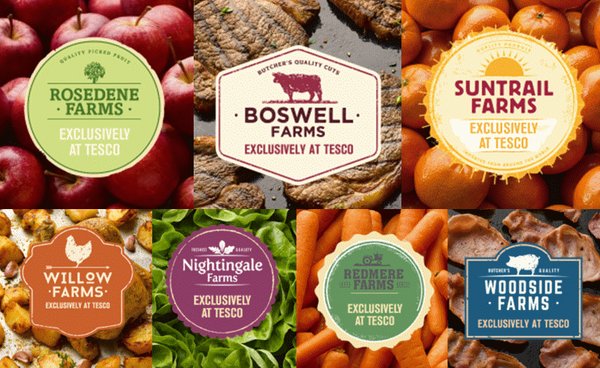
British supermarket giant Tesco has come under criticism after launching a new product range which is branded under a series of farm names – all of which have been created to “convey the quality specifications that go into every product across the range” according to a statement from the retailer, given to Fresh Produce Journal.
At a time when consumers want more transparency than ever when it comes to knowing where their food comes from, Tesco’s new brand rollout seems to have been primarily met with confusion.
The Tesco brand names represent a product, rather than traceable goods and produce from farm to supermarket shelf.
According to industry news site Farming UK, 76 products will be sold under the seven new brand names, which are:
- Redmere Farms, for vegetables
- Suntrail Farms, for imported Fruit
- Rosedene Farms, for berries, apples and pears
- Nightingale Farms, for salad
- Woodside Farms, for pork
- Willow Farms, for chicken
- Boswell Farms, for beef
But what if these farm names already exist? And if so, what are they actually farming? I did a Google trawl, so you don’t have to.
Redmere Farms: this one didn’t have much of a web footprint at all, but there does seem to be a Redmere Farm in Westleton, Sussex. And people seem to like hiking near it.
Suntrail Farms: according to the Florida Department of State Division of Corporations (found at the cheery and slightly unreassuringly-named sunbiz.org) there is a Sun Trail Farm business registered in Duette, Florida but not much info on what they actually produce. Maybe they do genuinely produce the imported oranges for Tesco as per their packaging?
Rosedene Farms: again not a lot of online info under this name, but according to business directory 118 118, there is pretty much definitely a Rosedene Farm in Wetherby, West Yorkshire which is almost certainly farming livestock.
Nightingale Farms: bit of a theme here. They all seem to be in North America and are all organic, sustainable or small scale. You can choose from Nightingale Farms in Ontario, which grows organic fruit and veg, small family farm Nightingale Farms in California which raises goats or family-run sheep farm Nightingale farms in Texas.
Woodside Farms: it turns out Derbyshire Wildlife Trust have a farming and conservation enterprise, near Ilkeston, where they raise wonderfully charismatic highland cattle and Jacobs sheep while preserving natural habitats. There is also a Woodside Farm in Kent, which is breaking new ground in the form of some kind of Parma ham-esque air dried lamb.
Willow Farms: Worcestershire-based Willow Farm is a mixed farm, with different types of livestock and bees, farming along sustainable principles. Or you could pop along to rare breeds specialist Willow Farm, a family-run business that works to provide high animal welfare standards. Or for something different, head to Jersey’s Willow Farm to get your fill of the eponymous Jersey Royal potato and pick up a nice bunch of daffodils while you’re there.
Boswell Farms: according to the LA Times this is also the name of an enormous cotton farm turned agribusiness giant in California. They seem to be still going in the face of the well documented droughts heavily impacting the sunny state, although the San Jose Mercury News slightly terrifyingly reported in 2014 that:
‘Cotton king J.C. Boswell Farms drilled five ultra-deep 2,500-foot wells last year. Each one is as deep as two Empire State Buildings, stacked underground.’
Surely that can’t be helping the California water shortages.
Bonus entertaining fact!
In the process of putting this article together, I discovered the joyous fact that two (two!) of the Tesco farm brand names are also names of farms on the BBC Radio4 long running rural soap opera The Archers.
Looking at you Willow Farm and you, Nightingale Farm!
So, @Tesco where exactly in UK are ‘Willow Farms’, ‘Rosedene Farms’ or ‘Woodside Farms’? https://t.co/fBIGrZt5oT
— Harry Wallop (@hwallop) 21 March 2016
That’s answered then. Sort of.
In the interests of fairness, it should be pointed out that Tesco is not the only supermarket who thinks that branding equals authenticity.
Aldi and Lidl both use this tactic and Marks and Spencer famously stocks ‘Oakham Chicken’ which led to a series of puzzled interviews with residents in the town of Oakham, as the BBC attempted to track down the M&S chicken farm in 2007.
But M&S has at least recognised that a food brand of this kind still needs to deliver traceability, and has since added the name of the farmer on each and every Oakham chicken.
The National Farmers Union chief food chain adviser Ruth Mason said: “It’s vital that shoppers have accurate, clear labelling on the origin of any British food or drink product in order to make an informed choice about what they are buying.”
Sources: The NFU, Tesco.com, BBC, The Guardian
 Green Dispatches